Breast Health
Regular self-exam of your breasts help you to know what your body feels like. Knowing YOUR normal helps you to know if your normal changes. Make an appointment at Women's Health Specialists for an initial clinical breast exam, and get reassurance from your clinician on how your breasts are supposed to feel!
Breast Screenings
For women under age 40, we offer an annual clinic breast exam, and risk evaluation with a WHS clinician. The clinician discusses with the woman her concerns, risks and screening options. The clinician and woman will devise a screening plan that the client is comfortable with. The client’s screening plan will also reflect what is in her best medical interest according to the ACOG (American Association of Obstetrics and Gynecology) recommendations. If a medical indication is found, we refer our clients for a mammogram.
For women over age 40, we offer an annual clinical breast exam, and annual screening mammograms. At WHS women are not denied exams or mammograms based on the new recommendations from the 2010 US Prevention Task Force. The Task Force recommends routine screening with mammography begin at age 50, followed by every two years. We provide information about the changes in recommendations for our clients, and assisting her in evaluating the risks and benefits of mammography.
Breast Implants
In July 2005, the Food and Drug Agency (FDA) stated that silicone breast implants were approvable. In December 2006, the FDA approves silicone breast implants - after a 15 year ban - even though the there were no changes in the device were made. See the National Women's Health Network fact sheet for more information.
Hormone Therapy
On October 21, 2010, The National Women’s Health Network reported that long-term use of menopause HT doubles the risk of dying from breast cancer. In other words, women that already have breast Cancer and are taking hormone therapy, are more likely to have aggressive cancer, compared with women who do not take hormone therapy.
Less Hormone Therapy, Less Breast Cancer from Women's Health Activist Newsletter, by Adriane Fugh-Berman, M.D., an excellent article about the decrease in breast cancer after women stopped taking menopausal hormones.
Self-Exam How-To
Click Image to Download a PDF Breast Exam How-To
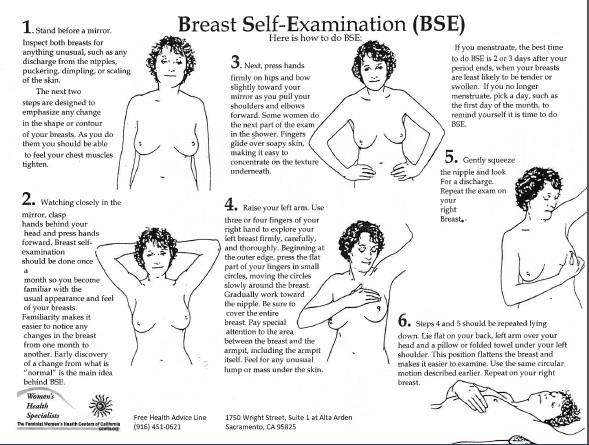
CLICK TO DOWNLOAD A PDF
Free Care For Women 40+
Payment: In the State of California there are different payment methods available to women who have no insurance or are underinsured. Please call Women’s Health Specialists at: 800.714.8151 to check funding guidelines for a care under those programs.
Mammography
Another controversial area surrounding breast health is mammography, digital mammography, sonography, and other breast cancer screening tests. Mammography uses a type of radiation to detect breast lumps. Digital mammography compresses the image into digital form so that the results can be read on a computer. This technique has been approved by the FDA, but is controversial due to false positive results, which lead to unnecessary biopsies. Read the Breast Cancer Action fact sheet about these screening tests for more information.
Breast Cancer Action has also made a fact sheet available on their website called "Breast Cancer Action Recommendations and Policy Statement: Breast Cancer Screening and Early Detection." You can upload or read it on their website.
Who Is Talking About Breast Health?
Perhaps the most controversial areas of women's health pertain to our breasts - especially breast cancer. There is certainly a high risk of breast cancer for women in the U.S. However much of the information about breast cancer and treatments is being generated by the drug companies that produce cancer causing chemicals used in our environment as well as cancer treatment drugs. As a result, the medical profession and the drug companies often ignore important factors such as the environment and the role of cancer causing drugs. Women's health activists must remain skeptical about their role in providing women with good health information about breast health.
Resources For Unbiased Breast Health Information
- National Women's Health Network: The National Women's Health Network is an independent "watch-dog" organization that offers analysis of drugs and drug research about the breast and many other women's health issues. They regularly give testimony to the FDA that has influenced how drugs effecting women get approved. This group is doing work that you can rely on. They have many fact sheets on breast cancer, prevention, breast implants etc. While you can get their information off their web site, consider joining this membership organization
- Dr. Susan Love:
- Breast Cancer Action: This is a dynamic, activist organization that does extensive work around all issues of breast cancer. The information on this site will open your eyes and give you concrete and helpful information about breast cancer and prevention. It also gives very helpful information to women diagnosed with breast cancer. Check out the FAQ's on this site if nothing else. While you obtain BCA's information from their web site, consider joining this valuable membership organization. Website for Breast Cancer Action: www.bcaction.org.
News Updates
On June 4, 2011, at the American Society of Clinical Oncology conference, Canada's NCIC presented the results of a study regarding the use of the drug exemestane (Aromasin), an aromatase inhibitor, for use in healthy postmenopausal women to reduce the risk of invasive breast cancer. Aromatase inhibiters make a woman's body produce less estrogen. (Many types of breast cancer are stimulated by estrogen, so the theory is that a reduction in estrogen will prevent cancer cells from growing.) Women's groups have analyzed the study results which are accessible at the Breast Cancer Action article.
June 29, 2011 Avastin update:The FDA's Oncological Drug Advisory Panel (ODAC) unanimously voted to revoke Avastin as a treatment for metastatic breast cancer. This decision is the result of many studies that demonstrated that Avastin did not improve women's quality of life or lifespan. Read more from Breast Cancer Action