Herpes
Herpes
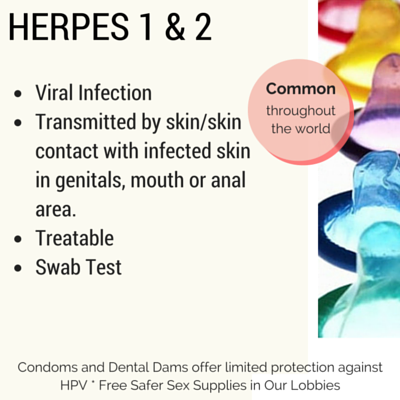
Herpes is caused by a virus, like the common cold, mumps and the flu. This virus does not cause serious harm, but can be passed to sexual partners. The first outbreak is usually the most severe. There is no cure for herpes. Drug companies have developed drugs, which may help with continued outbreaks. Although the best way to lessen your risk of recurrent outbreaks of herpes is to keep your immune system healthy.
There are three types of herpes virus:
- Herpes Simplex I (cold sores, fever blisters)
- Herpes Simplex II (genital herpes)
- Herpes Zoster (shingles)
Symptoms
If you have herpes, at some point in your life, you may develop:
- Develop painful sores on your outer genitals, vagina, cervix, buttocks or inner thighs that are diagnosed as herpes.
The first time a herpes infection develops; some of the symptoms may affect your whole body.
- You may run a fever and feel tired and run down.
- Later you may notice tender lymph nodes and a generally ill feeling.
- You may notice a tingling, itching or soreness, or a swelling in your outer genitals.
- Small, fluid-filled blisters will appear.
- These sores are reddish and develop a slit, similar to a paper cut through the center of the swelling.
- The surrounding skin may also be reddened.
- If urine touches the sores, it can cause a painful burning, and swelling around your urethra can make urination difficult.
- The sores often split, ooze, and scar over before they heal.
- The symptoms can last from 10 days to three weeks.
What are the health problems associated with Herpes?
- An open sore may make you more susceptible to contracting another STI during unprotected sexual contact.
How Is Herpes Transmitted?
The source of herpes is not known. Many researchers believe that the virus is transmitted through sexual contact, and consider it a sexually transmitted disease. Herpes may be spread through contact with the blisters at any time that they are visible. Men may have blisters in their urethras, where they cannot be seen. They may be unaware of a mild attack and transmit the disease unwittingly.
Confidential Testing
Get tested for Herpes at any WHS clinic. We test people of all genders.
Treatment
Staying healthy is your best defense for recurrent outbreaks of herpes.
Take these Vitamins and minerals:
- Vitamin C, 2-5 mg daily
- Vitamin B-6, 100 grams daily
- Zinc, 50 mgs daily
- Lysine, 500 mg/daily and 1000 mg/three times daily during active lesions
- Avoid foods with high arginine content - Chocolate, peanut butter, cashews, almonds, sunflower and other seeds, peas. oats, corn, coconut.
- Include foods in your diet that are high in lysine content - Brewer's yeast, dairy products, eggs, fish, potatoes.
Drug companies have developed drugs, which may help with continued outbreaks. Although the best way to lessen your risk of recurrent outbreaks of herpes is to keep your immune system healthy.
Test Your Knowledge
1. True or False: A person of any gender can give herpes to a person of any gender.
2. True or False: Herpes is transmitted via contact with infected skin.
3. True or False: Herpes is very common, worldwide.
4. True or False: You may have herpes for years and never have an outbreak.
5. True or False: The best treatment for herpes is to maintain a healthy immune system.
All True!